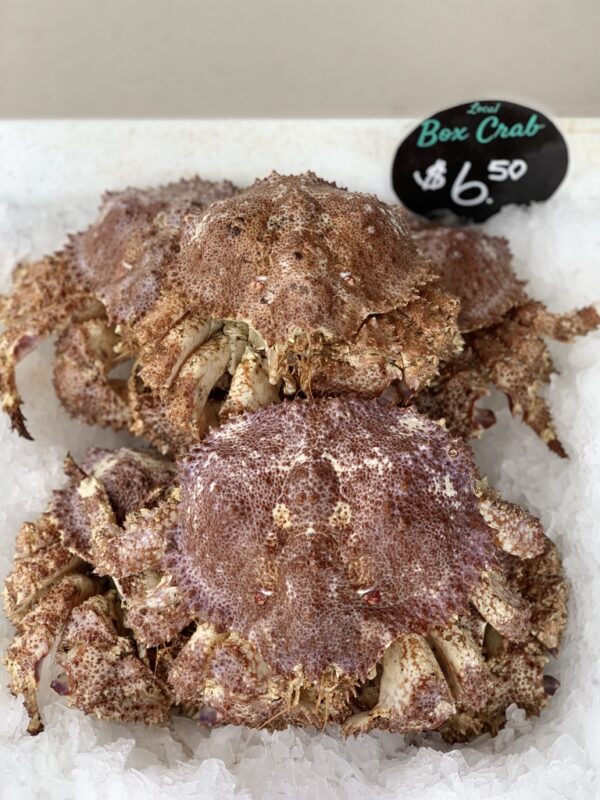
What’s Actually Going on With California Box Crab?
Posted on September 1, 2026 by Local Fish
Written by Tanner Saraspe, a third gen San Diegan from a fourth gen fishing family.
This week, a friend of mine, a good friend who runs a charter boat out of San Diego asked me something which I didn’t have an answer. We have been friends for years. We visited him in Thailand years ago on a whim and really until that moment, had no idea how well traveled he was. He’s got a real taste for great restaurants and unique food experiences, and he had charter clients who wanted to try the iconic California Brown Box Crab. This came after he ranted and raved about this eclectic local species. Years ago he secured a couple box crab that my dad had caught. As his memory serves him, they are the “best crab he has ever had”, sweet, high-yielding, beautiful in the raw, and beautiful once cooked. He wanted to know where he could take these clients to try box crab. A restaurant that actually has it, consistently, that could show these clients something they couldn’t get anywhere else… Honestly, I feel like that is one of my specialties. So entrenched in the local seafood scene, I was embarassed that I didn’t have an answer for.
I didn’t have a name for him off the top of my head, so I called a couple of my best chef friends and restaurant clients to see if they had it on their menu. Both of them came back with the same answer, more or less: “tell me where I can get it.”
That response is what really sparked me to dig into this a lot deeper than I expected to. I felt like “jokes on you”…
Growing up, box crab was a bonus
Back when we were selling out of the tuna harbor dockside market, box crab was a special addition to our offerings, but never because we went looking for it. It came up in the rock crab traps. They were never the specie of target, but they were that special cherry on top that had the entire downtown tourist population asking questions, and our asian clientele just going batshit crazy over it, ooohing and aahing. We’d set those traps deeper and in colder water than most people realize, and every so often a box crab would climb in instead of, or alongside, the rock crab we were actually after.
It wasn’t the target. I guess you could say it was the bonus. But, it wasn’t highly sought after until the dockside market sales proved it to be. It was convenient for us as sellers. It’s hard to find a restaurant willing to take such a small quantity, take the time to create the dish, and market the dish on their menu. But the ultimate consumers (end-consumers), were jonesing over it for their family. Something UBER unique.
I’ve always had a theory about why they taste the way they do, sweeter and firmer than a lot of the crab people are used to. Box crab live in deeper, colder water than our rock crab fishing grounds. It’s the same logic chefs use to explain why cold water lobster tends to taste sweeter than warm-water lobster: colder water means slower growth, and slower growth tends to mean firmer, sweeter meat. Colder water means more insulation and therefore sweeter, fattier crab meat (if that makes any sense).
I couldn’t find anyone who’s studied that specifically in box crab, so take it as an educated guess from someone who’s lived to hear the stories of san diego’s commercial fishermen who pulled a hell of a lot of traps, not a proven fact. But I don’t think I’m wrong about it.
Box Crab…They’re genuinely some of the most unique specimens I’ve come across in this industry, and I’ve come across a lot. It’s honestly hard to even fathom cooking them the first time you pull one out of a trap. They don’t look like something you eat. They look like something out of a tide pool exhibit. Something foreign and alien-esque. Might as well be a creature that arrived from a spaceship. But with some weird aesthetic appeal.
Then you actually cook one, and it gets even more beautiful. The color shifts and deepens right in front of you. Every chef I’ve shown one to has had the same reaction I did the first time.
So why can’t you just go catch them?
This is the part I went and actually looked into, because “it’s incidental catch” is true, but it’s not the whole story, and I wanted to understand the legal side of it properly.
Here’s what’s actually going on.
This became official as of January 1, 2019, under California Code of Regulations, Title 14, Section 126 (14 CCR § 126): box crab and king crab fall into a family called Lithodidae, and the state treats them as incidental catch by design.
If you’re already legally fishing for rock crab, spiny lobster, or Dungeness crab, you’re allowed to keep up to 25 pounds of each Lithodidae species, including box crab and king crab. But the total amount of those crabs you possess can never exceed the amount of your legal target crab or lobster catch onboard.
I actually asked a CDFW warden about this directly back when the rule was brand new, and he laid it out for me almost exactly that way: if you’re carrying 25 lbs of box crab and 25 lbs of king crab, you need at least 50 lbs of your target species (rock crab) to justify it.
That’s the rule that explains every box crab we ever sold. We weren’t fishing for them. We were fishing for rock crab, and box crab tagged along, capped by the amount of legal target catch we had to show for it.
I also assumed the base permit for all of this was simple open access, since that’s the term people throw around. It’s not, at least not down here.
California has separate northern and southern rock crab trap permits, with the dividing line at 36° N latitude at Lopez Point in Monterey County. The northern permit is available to eligible commercial fishermen, while the southern permit, which covers San Diego, is transferable and restricted.
So even the incidental pathway that gets you box crab at all runs through a restricted permit first.
The targeted fishery is tiny, and it’s still experimental
Wanting to actually target box crab, not just take whatever shows up, is a different question entirely, and California has only been willing to test that idea relatively recently.
In December 2017, the Fish and Game Commission directed the Department of Fish and Wildlife to build an experimental permit program to find out whether a real, targeted box crab fishery could even work. Rules were adopted through 2018, and the first boats began fishing under the program in 2019 with significant monitoring and data collection requirements.
That first program expired in 2023. A new one, EFP 2023-01, picked up the work, still held by one permittee, Kim Sawicki of Sustainable Seas Technology, with individual fishermen fishing under it as authorized agents rather than each holding a separate permit of their own.
In February 2025, she asked the state for a pretty significant expansion: statewide waters, more traps, higher catch allowances, 15 additional vessels and up to 40 authorized agents.
It took about a year to get decided.
The Fish and Game Commission approved a modified version of the expansion in February 2026, and what ultimately went through was smaller than what had been requested. The experimental fishery can now operate statewide, from the Oregon border all the way to the Mexico border. Fishing south of Point Conception, including San Diego, is allowed year-round, while waters north of Point Conception have seasonal windows that generally run from July into mid-November.
The permit can now authorize up to 20 fishermen fishing from five vessels, rather than the 20 vessels and 40 agents that had been requested. Each permittee can fish up to 200 traps, and the entire EFP is managed under a permit-wide total allowable catch of 500,000 pounds of brown box crab and 180,000 pounds of king crab per year, shared across everyone fishing under it.
So how does a fisherman actually get into this fishery?
You don’t just go to CDFW and buy a box crab permit. Right now, the targeted fishery operates through this existing experimental permit. A fisherman interested in participating has to connect with the EFP holder, Sustainable Seas Technology, and be added to the project as an authorized agent. The vessel being used also has to be authorized under the permit.
So there is a pathway in, but it’s not really an open fishery. You’re joining an existing research project with a limited number of fishermen and vessels, and you’re fishing under its gear, monitoring, reporting and catch requirements.
Which, to me, makes the whole thing even more interesting. The demand is clearly there, the state is actively testing the fishery, and there is technically a way for fishermen to participate. But it’s still a very small club.
Even that more limited expansion may be part of why box crab seems to be coming up so much more lately. At least from where I sit, I’m hearing about it more than I ever have before, from fishermen, chefs and people who simply want to know where they can eat one.
But even as the experimental fishery expands, the biology is still the big question.
Researchers studying Southern California brown box crab have documented females carrying more than 62,000 eggs and found evidence of an approximately 18-month reproductive cycle. Interestingly, the current minimum legal size was based largely on market demand, not specifically on protecting breeding females. But female box crab generally stay smaller than the legal harvest size, which means most females aren’t harvested and can continue contributing to the population throughout their lives.
That’s really the point of the experimental fishery. There’s clearly a market for these crab. What’s still being worked out is how much fishing pressure the population can actually support, and what a sustainable commercial fishery would need to look like long term.
Where that leaves us
So here’s where I landed, for my friend and for myself: I still don’t have a restaurant I can confidently point him to and say, go there, they’ll have local box crab.
Not because it can’t legally be targeted, and definitely not because the demand isn’t there.
The experimental permit exists. Fishermen are participating. And the chefs were asking me where they could get it the second I brought it up.
What’s missing, at least from where I sit, is a consistent bridge between the fishermen catching it and the restaurants that clearly want it.
And that’s the part that has me curious.
I don’t know yet if that bridge is going to involve us. But now that I actually understand the fishery instead of just knowing the shortcut version I grew up with, it feels less like a closed door and more like an open question.
If you’re a fisherman working with box crab, or a chef who wants it, I’d genuinely like to hear from you.
Sources
- Personal correspondence with Lt. Eric Kord, California Department of Fish and Wildlife (January 28, 2019)
- California Code of Regulations, Title 14, Section 126 (14 CCR § 126) — Commercial Take of Crabs Not in the Genus Cancer in Trap Gear
- California Code of Regulations, Title 14, Section 125 (14 CCR § 125) — Commercial Rock Crab Permits
- CDFW / Fish and Game Commission: Brown Box Crab Experimental Gear Permit Planning Update (2018)
- Fish and Game Commission Initial Statement of Reasons, box crab rulemaking (2018)
- Major Amendment Request for EFP 2023-01 (February 2025)
- California Department of Fish and Wildlife, EFP 2023-01 Approved Terms and Conditions, revised February 17, 2026
- Global Seafood Alliance: Experimental fishery program examining reproductive capacity of Southern California brown box crabs
- UC San Diego California Sea Grant: Brown Box Crab seafood profile