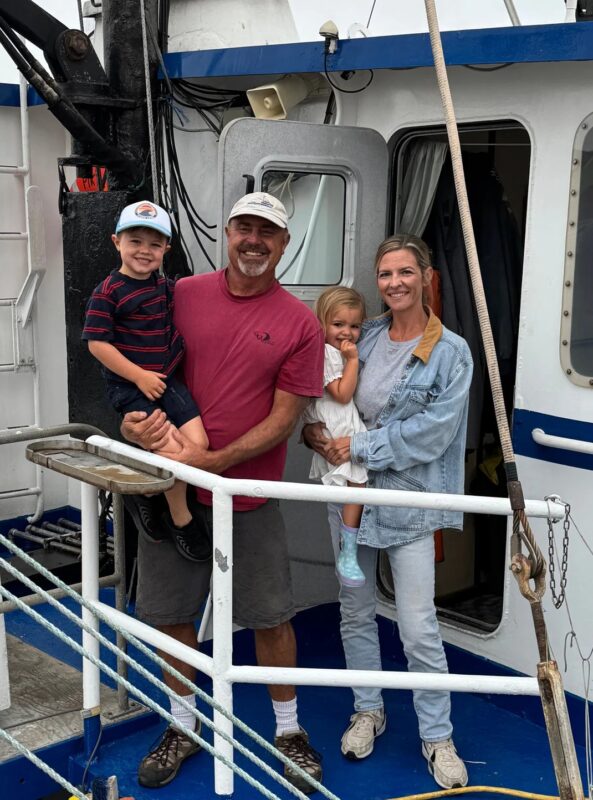
Interview With JJ Gerritsen and Jessica Rhodes- Craft Fish Co.
Posted on March 2, 2026 by Local Fish
Conducted by Thomas Fies, Program Operations Intern
HOW DID CRAFT FISH CO. GET STARTED?
JJ: All of the albacore that we catch is basically for canning purposes. It gets shipped off all over the place to facilities that process, can, and then distribute and sell canned fish. As we went along, we started to develop some markets that were more particular about the quality of the fish. Some of our buyers wanted us to bleed the fish, and they wanted them straight and round, and were specific about caretaking. So we started doing that, and we’re taking more and more care of these fish, and then we’re thinking, man, we’re doing such a good job at this, we’re way beyond industry standard. Let’s can our own fish and distribute it, because we feel that we absolutely, positively have the best-kept product that there is.
Jessica: I think we started canning for personal use and for friends and family about six years ago or so. Friends and family would want more. “Where can we buy it? Can we get more?” From that feedback, we decided [to start Craft Fish Co]. A lot of fishing is kind of middleman heavy, and so being able to have control of the whole process—JJ catching it, having it canned here in the United States, and then having me be on the backend doing the logistics pieces of it and shipping it out—to have that full control of the product was really our goal.
WHAT ARE SOME OF THE CHALLENGES YOU’VE FACED IN GETTING THE BUSINESS STARTED?
JJ: I think the competitive nature of the tinned fish industry right now. There are so many other people doing it that it’s felt really frustrating at times. Words like sustainability, Marine Stewardship Council, pole and line caught, and North Pacific—everybody wants to use those
words. Even the products that you are buying off the shelf that are screaming sustainability and pole and line are products that are not what they say they are. There are companies that are using farm-raised fish. There are companies that are twice cooking their fish. There are companies that are using foreign labor. North Pacific is anywhere in the Pacific Ocean north of the equator. I think people use that because it sounds like the coast of the Pacific Northwest, where we are. There are people in our area in the same waters we are that are doing similar things, but there’s no one, or at least not very many, that are actually marketing the fish they caught. Most of them are buying it, outsourcing it.
Jessica: Trying to figure out ways to differentiate ourselves, to get through all of that noise, because we do have a different product. It gets frustrating when you see people using the same verbiage you are, when it’s not the same thing. Another challenge would be the forecasting of how much fish to hold back to can. It’s a good problem to have, because we’re selling more than we anticipated. We’re way under-canned. But that’s a good thing. That’s what you hope for.
WHERE DOES YOUR FISH GET CANNED?
JJ: We actually have two canneries that we use right now, one’s in Washington, and one’s in Oregon. We went to the supermarket, and each cannery has a numbered code, so you can pick up a can of tuna and see which cannery canned that fish. We kind of went around opening cans of tuna and checking them out, and that’s how we boiled down the particular ones that we use—whoever made the best pack.
Jessica: Within the United States, there are very few canneries, and what we were looking for was these smaller artisanal canneries that, once the fish comes to them, they’re hand cutting the fish, hand filleting, hand cutting it into pieces, and that whole piece of the fillet goes into the can, hand-packed, and then cooked once. A lot of canneries cook the whole fish, scrape off the meat, and then that meat gets put into cans, and then those cans are cooked in the canning process. Whereas our fish only gets cooked once. That nutrient density is a lot higher in the fish that’s only cooked once. That was important to us as well.
WHAT SEPARATES YOUR PRODUCT FROM OTHERS?
JJ: I think part of that has to do with my experience coming from the sport fishing industry and just learning how to take super great care of every fish. When I got into the commercial industry, I saw how careless people really are about quality. If they catch the fish, they throw it on the deck, throw it in ice, and off we go. There are so many levels of ability when it comes to caring for fish. I would say the level we put into taking care of every fish is far beyond what’s required. I would say we’re Michelin-star quality, as opposed to fast-food quality, which is totally fine. Nobody complains about that. But I think that knowing that we can really, really, really up [the quality]—I’m hoping that more and more markets see that and want, specifically, our fish, because of that. And it’s happening.
Jessica: Tinned fish has kind of been on the rise in popularity. People aren’t just mixing it with a bunch of stuff and making tuna salad sandwiches. A lot of our customers, our kids included, and us as well, just eat it straight out of the can, or on crackers. It is a sushi-quality piece of fish that’s getting canned, which then has a huge shelf life.
WHAT DOES IT MEAN TO HAVE THIS BE A FAMILY OPERATION?
JJ: That is the coolest part of it. It could never work without Jessica. She’s the rock. I just step back, and I’m continually amazed by the level she’s able to reach with this. I go out and catch them. She’s mom full-time, and she’s the one pushing the product online, making the contacts, getting it out there, making all the posts, and generating all that. She’s done it all herself. She has had no outside help. She created her own website and creates all the little posts and pictures. It’s just her, and I, and those kids. It’s just incredible.
Jessica: It’s amazing. [The kids] get so excited when my phone dings and we have an order. I think it’s kind of teaching them too that we can do something we love together as a family, and hopefully make a living doing it. I think that’s a cool message. I homeschool Kyler, too, and so I kind of think of it a little bit as his business education. I feel pretty fortunate to be able to stay home with them. It’s kind of a necessary thing with JJ being gone for that many months to have some kind of consistency for them. But to be able to do something within this industry and have them help—I think as they get older, they’re gonna help more and more with it, or at least be a part of it. Being able to share that with them, it’s been really cool, and hopefully it’s something that will continue on and just keep growing with them.
The kids help us wrap the cans. They help put the labels on them. When we come in, it’s so classic how stoked they are just to be touching the fish. They’re nasty and slimy and they just want their hands in it. They love it. Commercial fishing is a challenge on families. JJ’s gone for four and a half months, five months sometimes out of the year. Having the kids understand that that’s why Dad’s gone—it’s because he’s working and he’s catching fish—I think it is helpful for them to see the end product.
WHAT ADVICE WOULD YOU GIVE TO YOUNGER FISHERMEN ENTERING COMMERCIAL FISHING?
JJ: Commercial fishing is a really, really tough way to make a living. It requires total commitment. If you want to make money, if you want to make a living in commercial fishing, you have to go into it with absolutely everything you’ve got and not give up. It takes a lot to get started. What it boils down to is that it’s a labor of love. You have to be passionate about fishing. If you are absolutely passionate about fishing, then commercial fishing is a cool thing to do, because you’re doing something you love. But it has challenges. You need to stay focused and stay in touch with the happenings in the industry in every way.
One of the cool things about being a commercial fisherman is that we’re on the water all the time. What commercial fishermen know, and many other people don’t know, is that commercial fishermen are the most environmentally conscientious people, aware of the environment and protecting it, because that’s where we make our living. I think there’s a real serious misconception where people think that commercial fishing is massively destructive, and people are going out there and harming the environment, but it’s quite the contrary. There’s nobody more environmentally conscientious than commercial fishermen. We are out there, firsthand, watching what’s happening with the environment, and protecting it. Fighting to protect it. But yet, at the same time, fighting to sustainably harvest part of its bounty.
WHAT ARE YOUR GOALS FOR THE NEXT 5-10 YEARS?
JJ: We’re just kind of dipping our feet in the pool right now and seeing where this goes. I think it would be really cool if we could get on a wholesale level, but I don’t think we’re gonna try to get on store shelves like Gelson’s, Vons, and Costco. We’re not shooting for anything that big. I think we want to keep it small-batch enough that we can still process our own fish. Once you get to a level like that, then you’re just like these other foreign canneries that are buying fish from anywhere they can and then shipping it to Vietnam to get it processed and canned. We don’t want to go that far. We’re going to try to stay small batch.
Jessica: I’d like to see our product in more of the boutique local stores. We’re in some wine shops and little stores like Fox Point Farms. We’d like to see our product get into more places like that, little bougie markets where people are into what we’re into.