Interview with Jeff Josenhans
Posted on March 12, 2026 by Local Fish
Kate: How did you find Local Fish from the restaurant side?
Jeff: It was kind of through the grapevine. I think it started through Fishful Future. Even before I knew about Local Fish as a formal platform, we were already trying to focus on local species. I grew up fishing and diving, so that connection was always there.
We started working primarily with Chula and other wholesalers, trying to get them to commit to specific species. That turned out to be challenging. When you put something general on the menu like rockfish, it does not tell the full story. Fishermen think in specifics. If I go fishing, I would never say I caught a rockfish. I would say I caught three vermilions, two Mexicans, one flag. That specificity is part of what makes fishing exciting.
But in restaurants, and especially on the commercial side, it was easier to generalize. That diluted some of the interest. We would try to commit to a species like vermilion, and then they would not have vermilion that week. There was a lot of back and forth. The idea was great, but execution was difficult because suppliers have to list and price fish differently.
Eventually, through Positively Groundfish and Fishful Future, we were introduced to Local Fish. We originally used the platform as a backup to Chula, but now, depending on the species, we often go straight to the fishermen.
Kate: What has your experience been like interacting with the platform?
Jeff: It has been really easy, which is huge. It is literally just texting people. That simplicity matters because chefs work long shifts. At the end of the night, they do not want to spend extra time navigating complicated systems. That is why they love pushing a button on a wholesale ordering system. So the fact that it is just texting fishermen makes it accessible.
We now have five or six go to fishermen that we primarily work with, many of whom we found through Local Fish. At first, I would go down and swipe my credit card on Square when fish were delivered. Now all the chefs have my card on file. Even if I am not there, they can purchase fish directly and I get notified. It is actually easier than dealing with traditional invoicing.
The Rolodex has been helpful too. We immediately isolated the fishermen located in San Diego Bay because that is closest to us, but we have also connected with guys in other harbors. I really like that you include Instagram handles. That adds a marketing element that we do not see from other suppliers. When fishermen tag us or post about us after we buy fish, it creates exposure for both sides. That has real value beyond just the cost of goods.
Kate: Have there been any species that felt exciting or new?
Jeff: I would not say completely new species, because I already know most of them, but it has allowed us to be more intentional and seasonal. That was part of why we created the Behind the Catch dinner series. We wanted to tie the environment to the species, not just focus on the commercial side.
In winter, we focus on winter species. In summer, pelagics. The platform has made it easier to access those species when they are available. Lingcod was exciting. It is not easy to commit to 20 lingcod every weekend, but when they show up, it is fun to feature them.
We also featured mako shark one week when weather was bad and rockfish were scarce. A fisherman had mako, so we built a feature around it. That flexibility is important.
I have learned that commercial availability does not always match recreational fishing experiences. For example, yellowtail feels like such a core San Diego species. It is iconic. But commercially, it is not always accessible because of regulations and geography. That has been an interesting realization.
Kate: How do customers respond to this focus on local species?
Jeff: They love it. We have guests who have attended five Behind the Catch dinners in a row. Others have been to three or four. It is a unique format.
We try to tell stories beyond just the commercial aspect. Some guests are interested in the fishermen and that industry perspective, but most people connect more with the species and environmental story.
For example, when we had sheephead on the menu and explained that they change sex over their lifetime, that detail alone sold the dish. People love those biological and ecological stories. It is almost more of a National Geographic approach than a commercial fishing story.
I think there are two audiences. Some people are into the gritty fishing side, like reality TV shows focused on crews. But I think most diners respond more to stories about the species and the ocean. As someone who spearfishes, I have a deep appreciation for fish and their environments, and I think connecting those dots is powerful.
Kate: How has your experience been working with the Local Fish team?
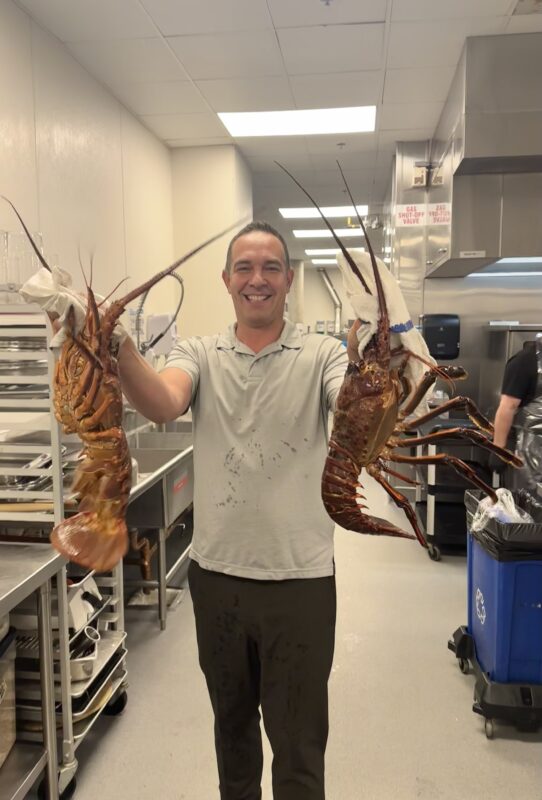
Jeff: It has been great. Tanner has been incredible. She saved us on Valentine’s weekend. Everyone was out of spiny lobster. Chula was out. Catalina was out. We were planning to feature spiny lobster and were close to being without it.
I texted Tanner asking if she knew anyone with lobster. She immediately sent five contacts. We texted all of them, and one guy was literally pulling traps when we reached him. We ended up buying 60 lobsters. Without that connection, we would have been in serious trouble. That kind of responsiveness is huge.
Kate: Is there anything you would like to see Local Fish expand into?
Jeff: One pattern we have noticed is that when we incorporate the recreational fishing side into our dinners, it resonates strongly. For example, we partnered with a jig company for a yellowtail dinner and brought in a recreational spearfisherman who had produced a documentary about white sea bass. Those dinners sold out quickly.
There is a large audience in San Diego that is deeply connected to fishing recreationally. They respond to seeing their world represented in a restaurant context. It creates another layer of connection.
At the same time, commercial fishermen are the foundation. But I do think there is more to explore in bridging those communities.
Kate: Any final thoughts?
Jeff: I think what you are doing is great. It takes intention to find and build relationships with small scale commercial fishermen. It is a small industry here. It is not easy to just discover these guys.
I also think the younger generation of fishermen being more tech savvy helps. They can update their profiles and handle texting and payments more easily. It is exciting to see that progression.
Overall, I think there is real momentum in reconnecting restaurants to fishermen and telling a more complete story about seafood in San Diego.