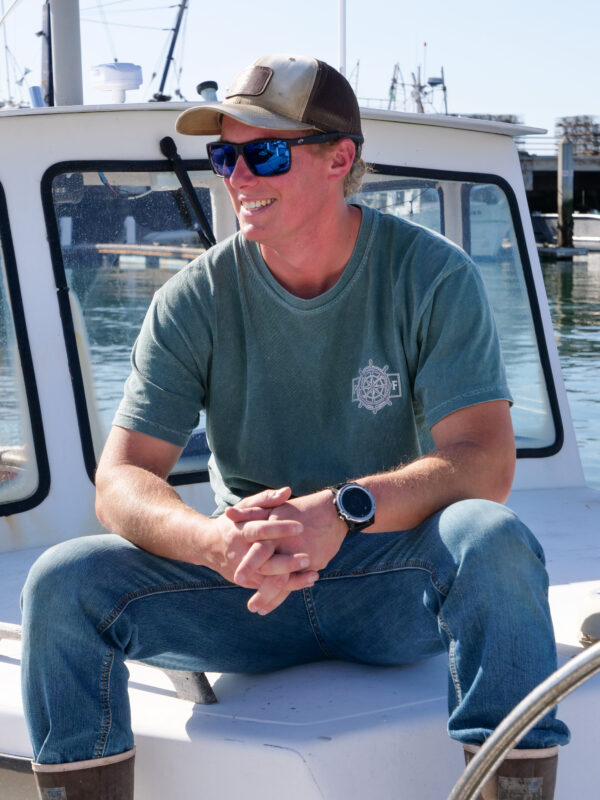
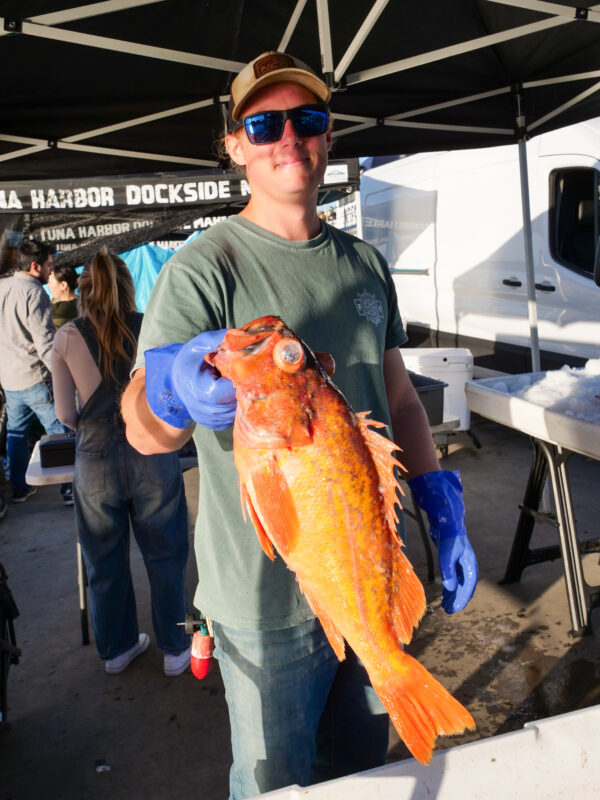
Interview with Forrest Bogue
Posted on March 16, 2026 by Local Fish
Kate: How did you get into fishing? Can you tell me a little about your background?
Forrest: My family on my dad’s side, which is really who I grew up with, are originally from the Azores Islands off Portugal, specifically Faial and São Jorge.
Back in the mid to late 1800s, one guy in the family hopped on a British whaling ship, allegedly as an indentured servant. I cannot prove that because there are no official records, but that is the family story. He spent three years at sea, jumped ship in Provincetown, Massachusetts at about 15 years old, and then called back to the rest of his family in Faial and told them there was opportunity in the cod fishery.
That is basically how most of my family came over.
Both my mom and dad were commercial fishermen. I grew up roaming the clam flats with them. Shellfishing is a big industry in New England, so that is how I started, digging clams and quahogs with my bare hands.
My dad owned an offshore scalloper and I worked on that. One summer we switched to quahog dragging. I tried that for a little while, but working 36 hour shifts as a 12 year old kid kind of put a sour taste in my mouth, so I quit for a bit.
I went off and did construction, landscaping, auto body work, and things like that. Then I went away to college, but the best money I could make was still shellfishing, so I used that to pay my way through school.
After that I spent nine years in the Navy here in San Diego, which is what brought me out here. I did a lot of recreational fishing while I was stationed here and kind of fell back in love with it.
Originally I was planning to leave the Navy and go into an MBA program, management consulting, finance, banking, basically working for the man again. But I had some personal things happen in my life and realized that was not the path for me.
So I decided to start my own business and try to do things a little better than what I had seen my parents go through.
And now we are here.
Kate: That is an amazing story. It is so true that the industry has changed a lot and will continue to change, which is really interesting to watch.
Kate: What is your favorite thing about fishing? Why do you choose this path?
Forrest: Like most fishermen, I think it is freedom.
You get to choose the type of fish you want to go after. I chose rockfish because it is a staple species here in Southern California. Growing up in New England, I loved the culture of fishing, so I wanted to find something out here that I enjoy doing.
It is really the freedom to change as you go. You can change your gear, change the areas you fish, and experiment with different techniques. There is an exploratory aspect to it.
You are your own person. You are doing it for yourself and your family. It is yours to build into whatever you want.
Kate: I really like that.
Challenges in the Fishing Industry
Kate: What are some of the biggest challenges you face in the industry? And if you could change something about it, what would it be?
Forrest: I think this is something that is pretty particular to San Diego, and I will use Massachusetts as an example.
In Massachusetts there is more of a pathway into the industry. You start out as a greenhorn making maybe fifty dollars a day. You work your way up to a full time deckhand position at full share. You learn the ropes and eventually work your way toward becoming a captain.
Out here the commercial fishing industry does not really have that kind of clear pathway anymore. Back when the tuna fleet was here, a lot of people were involved with the canneries or the boats. Mechanics, deckhands, captains. There was a structure to it.
What is wild to me is that there is actually a lot of opportunity here. I can groundfish with about a thousand dollars worth of permits. In New England that kind of entry would cost hundreds of thousands of dollars. Some permits back there are three hundred, four hundred, five hundred thousand dollars.
So while the infrastructure and markets are more established there, the barrier to entry is incredibly high.
For me, I want to be part of a revitalization of what is happening out here. I know I am not a local. There are families like the Saraspe family who have been fishing here for generations and are doing everything they can to keep it alive.
But I still feel some responsibility to help where I can. Back on Cape Cod we would call someone like me a wash ashore. I guess I am a wash ashore here too.
Kate: I understand why you would feel that way, but honestly coming into the industry with your perspective and wanting to contribute to the next generation of fishing is really inspiring.
The Next Generation of Fishermen
Kate: As a younger fisherman, what is your perspective on the next generation? How do you hope the industry will evolve?
Forrest: I think the future is less about volume and more about quality.
In New England I have friends who own gillnet boats and bring in thousands of pounds of fish per day, but they are getting something like .27 cents per pound.
Out here maybe I am getting six dollars a pound, but I am selling two hundred pounds a week to one wholesale buyer. Then I diversify. I might sell at a dockside market or directly to restaurants.
There is more of a business component now than there used to be. It is not just catch fish and sell fish anymore. Young fishermen have to think about branding, marketing, relationships with chefs, and maintaining top tier quality.
So the skill set required today is much broader than it was years ago.
Kate: That makes a lot of sense.
Working with Chefs
Kate: What has your experience been working with chefs here in San Diego?
Forrest: It has been great. Restaurants that are locally owned tend to be really excited about local fish.
For example we work with Vistal through Chula Seafoods Wholesale. Even though it is technically part of a larger hotel group, the hotel manager is a local San Diegan who fishes and is really passionate about local seafood.
Working with local restaurants has been amazing. I have actually learned way more about the restaurant industry than I expected. The chefs are really receptive to paying a little extra for quality fish instead of buying something imported from Norway or Scotland.
They want something from California. Even if it is Dungeness crab from up north, it is still California seafood.
Kate: Exactly. We have such an incredible variety of species here, but sometimes consumers are just unfamiliar with them. Chefs have a really cool way of making those species approachable.
Forrest: For sure.
Favorite Restaurants
Kate: Do you have a favorite restaurant in San Diego?
Forrest: That is a tough one.
Saiko Sushi has a special place in my heart. When they were open in North Park I used to go there, order off the menu, drink probably too much sake, and sit at the bar chatting with the bartender.
Another one is Mabel’s Gone Fishing. I had a great great grandmother named Mabel. She was married to the original ancestor who came over from the Azores. When my wife and I went there it felt kind of funny. But the food was phenomenal. That place really stands out.
A Story That Shaped Him
Kate: Do you have a favorite fishing story?
Forrest: I do not know if it is my favorite, but it definitely stuck with me.
Fishing is a tough industry. You have to love the craft. It is not just catching fish. It is mechanics, electrical work, fiberglass, welding, everything.
My dad once designed and built his entire mast and boom system from a sketch he carried in his pocket. He would pull the napkin out and start welding.
One trip really stuck with me. My dad had hired a guy he had known for years as his first mate. It was me, my dad, the mate, and another crewmen on the boat.
Something happened and the guy got angry and threw a knife across the wheelhouse at my dad. He quit right there in the middle of the trip.
Then crewmen got seasick and went below deck to sleep. That left me, twelve years old, hauling in a ten foot dredge, dumping it, culling scallops, carrying them to the shucking house, shucking them, and setting the dredge back out again.
After all that my dad said, “Alright, we have to find a new crew.”
I asked if we were taking time off.
He said no. We go tomorrow.
At the time I was just mad. I was a kid and did not want to work like that. But looking back now, after dealing with mechanical problems and setbacks of my own, I understand it.
You push through it because you love it.
Fishermen really love what they do. It is hard to find that kind of passion in many other industries.Kate: That is a perfect way to put it. Thank you so much for sharing that.