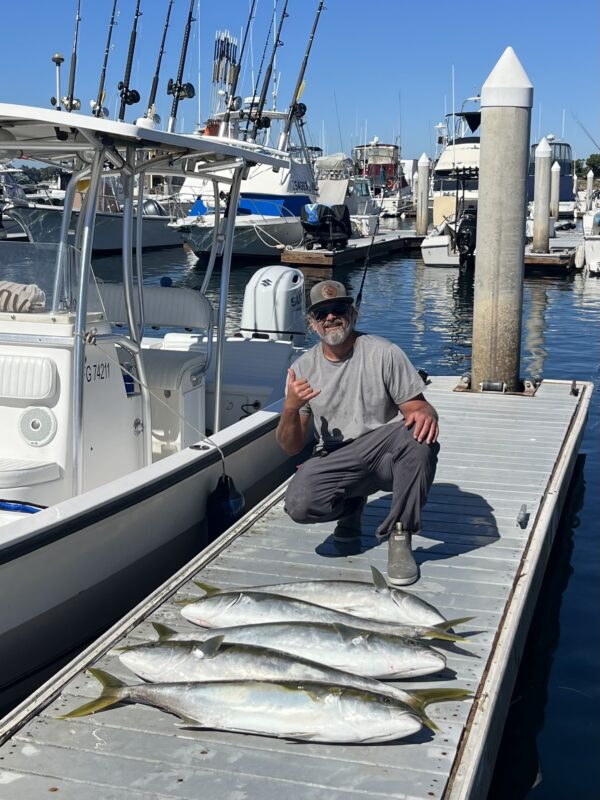
Interview with Corey Wyrick
Posted on March 10, 2026 by Local Fish
Kate: How did you get into fishing, and how long have you been fishing?
Corey: I’ve been fishing in some form or another since I was a little kid. I think the first time my dad took me fishing I was probably four years old. I grew up in Indiana and lived there until I was about 22. As a little kid, it was pond fishing and lake fishing in Indiana.
We would go to Florida on vacations, and that’s where I got into saltwater fishing as a kid, fishing off the piers. Every once in a while we’d go out on a boat, either a charter boat or a friend’s boat.
Then my parents started spending more time in Florida. They got a boat, then got a condo, and started doing more fishing there during my teens, and occasional trips during college.
Aside from that, it was all Midwestern freshwater fishing. That grew into fly fishing for trout. I moved to Colorado and had a couple of years of a snowboard-bum phase after college. I lived in Breckenridge, trout fished all summer, and did some guiding out there.
Then I ended up in San Diego for career and education reasons. Coming out here, it was really exciting to live by the ocean and be able to saltwater fish. I was in my mid-20s at that point.
I found La Jolla pretty quickly. My wife took me on a three-quarter-day trip to La Jolla for my birthday. There were five or six guys fishing from kayaks around the boat, and I remember thinking those guys had it dialed in and that I needed to do that.
I found a neighbor who had a used kayak for sale, bought it, and got really into La Jolla kayak fishing in the early 2000s, around 2002.
That progressed into working for Malibu Kayaks for a couple of years as their sales manager and the manager of their kayak fishing pro staff.
From there, I graduated to fishing off boats with buddies and then bought a boat in 2010. It was a 17-foot Mako center console. My daughter, Mazzy, was born that year, so I justified the purchase by registering it commercially and started fishing commercially for yellowtail, white sea bass, and halibut.
That year lined up with a big squid cycle. There were a lot of squid nests and really good fishing, so it was a productive first year. It has continued to develop since then.
I’ve upgraded the boat since then. Now I have a 26-foot center console, an offshore-style panga called Pesca Vida. Now it’s less about sitting on squid nests and more about chasing bluefin tuna, although we did have some really nice squid nest fishing this fall, which is easier on the fuel bill.
Once I got to San Diego, fishing was the main thing I wanted to do.
Kate: Especially growing up away from the ocean, that must have been huge.
Corey: Oh yeah, definitely.
Kate: What’s your favorite thing about fishing? Why do you love it so much?
Corey: That’s a good question. There’s a lot about it. I really love being out on the boat. Every day starts with this feeling of limitless possibility. You never know what you’re going to find.
It’s a surprise every time, but it’s not just luck. You have to use your skills, knowledge, and experience to solve a puzzle every time. That makes it really rewarding to go out there, do all the things you need to do, and then be rewarded for it.
I love fish. I’ve always been interested in fish, so holding one in your hands is pretty awesome. The whole process, the gear, being out in nature, making it happen, and then the reward at the end—it’s all part of it.
Kate: What are some of the biggest challenges you see in the industry right now? The less beautiful side of commercial fishing?
Corey: Sometimes you don’t find what you’re looking for. I’m fortunate that this isn’t my primary income. It’s a secondary business, so if I’m grinding trying to catch things that aren’t there, I can focus on something else for a while.
One thing that would help is finding markets for other types of fish that are common here but not very marketable. For example, right now you could fill a boat with bonito, but there’s not much of a market for it.
A lot of people don’t realize bonito can make really good sashimi and poke, but it’s not known as a commercially viable fish. If we could establish markets for species like that, commercial fishing would be more viable long term.
Another challenge is infrastructure. Commercial fishing on TV looks streamlined—boats pull up, fish get offloaded, ice is sprayed. In reality, we’re dock-carting fish into pickup trucks and driving them around town.
That can be a drag, but it’s part of it.
Treating fishing as a secondary business lets you capitalize on good times and spend time doing something you enjoy, which is rewarding.
Kate: Last question, just for fun. Do you have a favorite restaurant in San Diego that serves local seafood?
Corey: I have two. The Fishery on Cass Street in Pacific Beach, and El Pescador Fish Market in La Jolla. Those are the two main places I sell my fish, so I definitely have to shout them out.