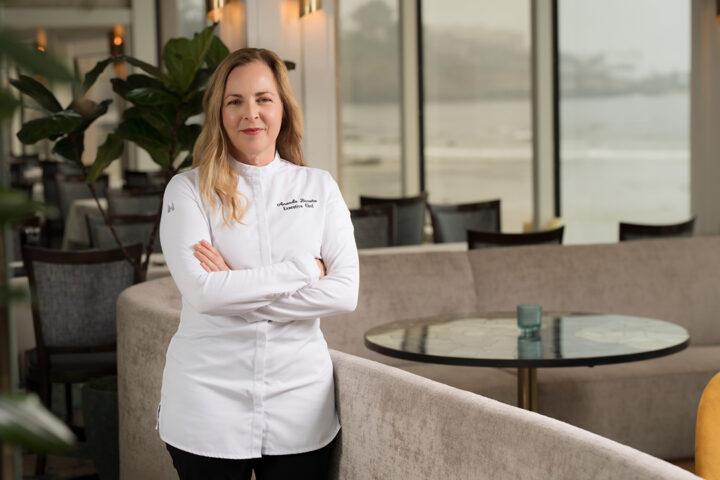
Interview with Chef Ananda Bareno
Posted on December 30, 2025 by Local Fish
Kate:
Okay, awesome. I have you recording. Perfect. I do have a few questions to guide our conversation, but feel free to explore your own tangents and let the conversation flow naturally. But I’d like to start by talking about how you got into cooking and your background story of becoming a chef, in as much detail as you’d like to share. But yeah, we’ll start there.
Chef Ananada:
Of course. Well, I mean, I probably started the same way that many people have started—with family. So, you know, for me, it was my great-grandfather and my grandfather who were kind of the cooks that drew me in.
My grandfather had a house in the Mission Bay area and a beautiful garden. Every time that I would go to stay there, it’d be to go out and pick whatever I wanted from the garden and then come in. And then we’ll create dinner around that together. You know, he grew caper berries, everything. It was really cool.
And then my great-grandfather, too—he was an Italian-Mexican food enthusiast and ran the entire day. So it was, ‘What are you going to make for breakfast?’ and ‘What are we going to make for dinner?’ He was the one who did everything. And so I would often love to go over and stay with him, cooking family meals.
And then my dad’s part of the family is all Mexican. So that side, I mean, the tamale parties and the different—like they all live south of the border in Tijuana. So I was always going down there, and food was just something that everybody centered everything around. And that’s how everybody came together, and you would have all the conversations and the history. I have all my grandma’s recipe books and various other items.
I mean, it’s something that just drew me in. So when I was—I jumped around and did lots of different things. I had also worked in a kitchen in Seattle at a fine-dining Malaysian restaurant. And that I was really into. But then I kept going in and out of it. But it always drew me back.
I finally reached a point where I decided this is what I want to do with my life. And I went to Paris, and I went to culinary school there, and I worked there at a Michelin-starred restaurant, and I just fell in love with the entire, you know, seductive part of the kitchen and how the family is and how the work ethic is and just really went headfirst.
When I came back to the States, I ended up—I went to some restaurants. I found the culture in the restaurants I got into was a little worse than it was, you know, back in Paris, where we had people working for us who were actually being paid under the table, and the owner was taking advantage of that.
And he basically, if anybody ever put any effort into making changes in anything that they were doing in the restaurants, he would say, If we do that, then we’re going to fire all these people because they’re not legal. And it just became a really horrible place to be.
And, of course, these people —I love them. So, it’s as if I didn’t want any trouble for them. So, I ended up leaving that restaurant.
And then that drew me into hotels because there was a hotel opening, and I ended up getting in there, and you had a lot more structure around it. There was significantly more protection. Everybody was treated better than in just a small, free-standing restaurant.
And then, yeah, I worked my way in and out of hotels from San Diego. I went to Maui. I worked with the Four Seasons Hotels in the Middle East. I worked in Syria, Jordan, and Costa Rica, and then came back full circle to San Diego, where I’m from.
Kate:
Wow, you know, it’s been nice. It’s been a nice journey. It’s brought you to so many different places, it sounds like. Is there anything about, besides the environment of treating workers and such, but why do hotels, over restaurants, draw you in? What are some positive aspects that you’ve experienced by working in hotels, and how’s the clientele different? I’m curious.
Chef Ananada:
Yeah, I loved working in some of the freestanding restaurants. But I think that in hotels, I like it because there’s so much—I mean, especially being with the hotel group like Four Seasons. I mean, they always treated everybody so well.
It was one of those things where they always just said, We live by the golden rule. So everyone treats each other as they wish to be treated. And that really was great, a through line.
But for me, it’s the opportunities. You know, I was adventurous. I was excited to go wherever and try whatever, and really immerse myself in different cultures, rather than being stuck in one spot.
And with a hotel, it opens up that door for you where you’re able to have opportunities if you’re willing to go and travel away and go, you know, get away and put yourself into it. Then you can go anywhere.
I mean, we even got to the point where my husband was offered a position—because he’s also a chef—and it was in the Serengeti. And it was an opening for Four Seasons. It was right on the safari reserve, where elephants would come up and drink out of water that was right up against your infinity pool.
And we were both just all in. We’re going to do this, for sure. And then we realized we had just had a baby. And we thought, ‘This isn’t the best place to take a kid.’
But both of us being adventurers, we were like, yes, we’re in. And then when we started talking about it, I started thinking like a mom and a little more like, okay, well, what if the baby got sick? Where do you take them to the hospital? And they said, Oh, we’d actually have to fly you to Kenya because there’s no—so we realized that this is a big game reserve. They said there are wild animals everywhere, and there’s nowhere to walk a stroller.
Then we started realizing, ‘Oh, this is probably not the best.’ But if it wasn’t for having a child and wanting to settle in some ways, I mean, we probably would—who knows what country we would be in today.
Kate:
Absolutely amazing. What an incredible story and what an extraordinary adventure that it’s taken you on. I want to transition more towards seafood and local fish. Do you have a favorite local species that you enjoy working with, and why?
Chef Ananada:
You know, I mean, we love to work with rockfish. It’s one of those fish that’s relatively abundant. For sustainability, it’s one that many people don’t work with, and therefore, it is very plentiful. So I think for that side of it, I’d say the rockfish.
Kate:
Awesome. What do you like to make with rockfish? Do you have a favorite dish?
Chef Ananada:
Ceviche. We like to make ceviche here.
Kate:
Do you have any advice for a young chef on sourcing local seafood? And why do you think it’s essential to work with fishermen and utilize what we have domestically, rather than importing or relying on large retailers and wholesalers?
Chef Ananada:
Yes, more so now, people entering the industry want to buy local. They want to support their neighbors. They want to help their fisheries, local produce vendors, and other local businesses.
So it’s like, I think that as we grow and the influence of social media and different things, it’s expanding people’s minds. I believe in the past, you saw a lot, unless you were living in countries where, for instance, when I lived in France, you pretty much went to your local fishmonger, butcher, and cheese shop.
However, here you don’t have that consistency as much because Sysco can drop off your order six days a week, and you’ll always have the same product.
Being able to fluctuate and tell the stories is what makes it better for both the guest and us, and enables you to bring in that product. Because as long as you have flexibility and you know that that story can stay the same, then you’re really helping somebody who helps the ecosystem.
Before I became a chef, I actually worked for Greenpeace. I did a lot of work where—so the guys laugh at me here because I got arrested doing different things, where we would go out and blockade a factory trawler or climb up and lock onto the side of their ship so they couldn’t go out, to bring attention and awareness to overfishing.
And so now it’s come full circle, where it’s nice to be able to really make those partnerships and take action, because now the power is in our hands to purchase that, rather than buying a frozen box of seafood that you’re just going to defrost.
And then you’re able to tell the story of that fisherman and show people also that this is something we can get right here in San Diego. And this is how it can be prepared. And that way it opens their eyes to where they can get that fish and what they can do with it.
Kate:
Yeah, and I feel it’s a different skill. Correct me if I’m wrong, but it’s a totally different skill to work with fresh seafood that you have to take the time and patience to prepare, versus getting something that’s pre-wrapped or pre-filleted. I imagine it builds a lot of confidence and skill among emerging chefs, sous chefs, and others in the kitchen.
Chef Ananada:
Exactly. And I think you have so much more pride and investment in that as well. If you’re on autopilot — say you’re doing a banquet for 500 people and you know you need salmon — that’s going to be a different story. But you can still try to do what you can.
Here at The Marine Room, we’re able to say, “I just got this local fish catch in, and I’ve only got forty servings,” and then sell out that night and move on to something else. People love that.
Kate:
Absolutely. I think that’s the case for a lot of restaurants here. The effort and the space can be limiting — there are definitely restrictions, which is understandable.
Chef Ananada:
Yes, you definitely need a place that can accommodate it, because with larger fish, you have to be sure you’ll be able to sell them.
Back when I was at Alila Marea up in Encinitas, we would get in whole tuna from Saraspe. We’d break them down and divide the cuts among different outlets, so nothing went to waste. We’d sell out within two days and wait for the next one. It’s nice to be able to showcase the fish, use everything, and not waste a thing.
Now, with dry-aging, a lot of chefs can hang and age the fish so it can be used continuously as it develops flavor.
Kate:
That’s awesome. I’m not as familiar with how you use dry-aging in restaurants. What parts of the fish do you dry-age? I’m asking purely out of curiosity.
Chef Ananada:
You remove the scales, hang the fish, and you can dry-age the entire thing.
Kate:
That’s awesome. Definitely has an expiration, though, right?
Chef Ananada:
Yes — you don’t want to go too long.
Kate:
Awesome. In your experience, how does local catch hit differently — in taste, in how clients respond? How do people’s reactions differ when they’re eating local species?
Chef Ananada:
It depends on where you’re at, but if you have the clientele that’s ready and has the appetite for it, it brings so much more to what you’re doing.
For us as cooks, it’s more exciting when you have that relationship with the fisherman — when they call and say, “Hey, I just caught this. Can you use any of it today?” You bring it in, and that connection makes it special. It’s not the same as getting anonymous boxes dropped off by a distributor.
Our guests love those stories too. We just hosted a wedding where the groom wanted to know where the fish came from — which vessel, which fisherman — and he insisted everything be sustainably sourced because his father was a fourth-generation fisherman. That was deeply meaningful to him.
Kate:
Totally. And I feel more and more people are becoming educated about why that matters, asking chefs and servers about sourcing. It’s great to hear that’s reflected in your work.
Chef Ananada:
Yes, absolutely. Education is key. I love when our purveyors come in and talk to the team — especially the front-of-house team — about why sustainability matters. They soak it up like sponges, then go to a table to share that story firsthand.
If you’re in the right place, surrounded by people who want to learn, everything changes. As we see what’s happening in the world, it’s becoming more important to people to know where their food comes from and how it’s harvested — not only for their own health, but for the planet.
With fisheries, it’s easy to default to the favorites — salmon, tuna, hamachi — but if we only fish those, we’ll run out. It’s about showing guests that these local, sustainable species can taste just as good and be caught right here.
Kate:
I love that. That’s a great point. Knowing what Local Fish does, and our mission, how can we better support restaurants like yours in getting more local fish into kitchens? Any ideas, even if they’re future-focused?
Chef Ananada:
For us, it’s a bit easier because we have several outlets and can use the fish in many ways. But I know it’s tough — we’re in service on weekends, especially Fridays through Sundays, which is when the local fish markets happen. We can’t go away because we’re working.
Having a service that cuts out the middleman — where you place an order and it’s delivered straight from the fishermen — is ideal.
Over time, when it comes to large fish, it could help to have partnerships between properties. For example, one restaurant could take half a swordfish and another could take the other half. That would let smaller places participate even if they can’t sell a whole fish themselves.
Kate:
Absolutely. That’s something we’re always trying to work on — figuring out how to manage whole-fish sales while still making it accessible for smaller restaurants. Maybe breaking them down and sharing cuts could be a great model.
And for my last question — ending on a good note — what’s your favorite spot to eat in San Diego when you’re not at work?
Chef Ananada:
It’s hard because I’m always working! But right now, since I have a kid, that’s changed where we go out. I’ve really been enjoying Wildland, and I also love Atelier Mana.
Kate:
Amazing. Perfect. I have so much great material here — thank you so much, Chef Ananada.