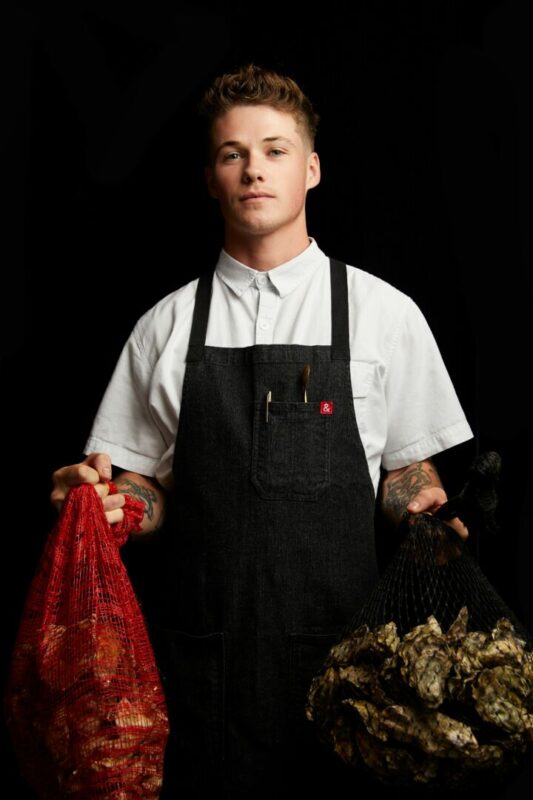
Interview with Chef Aidan Owens
Posted on January 22, 2026 by Local Fish
Kate: To start, I would love to hear your background! What first got you into cooking? How did you become a chef? What brought you to the United States?
Chef Aidan: I was born in Australia, right by Bondi Beach at Randwick General. I moved to a place called Byron Bay, which is a little hippie town where we raised chickens and ducks and lived right next to the ocean.
Bondi is attached to Sydney, and Sydney has Circular Quay, known for some of the best seafood in the world. I grew up around really good seafood.
From there, I moved to Brisbane, then to San Francisco, which also has an insane seafood culture. When I got to San Diego, I noticed that not many people were using local fish. Then, I got to Herb & Sea and saw that Chef Marissa was sourcing from local fishermen. I was excited and dove in headfirst!
Kate: Do you have a favorite species you enjoy working with? How do you approach underutilized species or encourage people to try something unfamiliar?
Chef Aidan: Day to day, for myself, I like rockfish. It is clean and easy to make a meal out of. For the restaurant, tuna is great, and white seabass is a killer here. Some of the bigger fish are wicked.
I also love mackerel. People might consider it uncommon, but it is really good, and we use it a lot. We also love skate.
Kate: What do you make with skate?
Chef Aidan: When you break skate down, it flakes apart a little bit, so it replicates the texture of crab. We chop up the wings, throat meat, and cheek meat, then sear them hard in a little beef fat. We add chili flakes, capers, lemon juice, and make a linguine or something like that. It is delicious.
The cool thing about skate is the liver. They are huge. We make liver pate out of them. Same with mackerel. We make liver pâté from mackerel livers. Black cod has really big, plump livers, too, and we make pate out of those as well.
Kate: That sounds incredible. What about swordfish?
Chef Aidan: Yeah, we put swordfish on the menu during this time because they are getting caught like crazy, but they are massive. Three hundred fifty pounds. We fly through tuna much faster. People buy more tuna, and we have more uses for it, like crudos.
Kate: What advice would you give to upcoming chefs about sourcing locally and working directly with fishermen?
Chef Aidan: As a chef, you do not get out of the restaurant much. Going to the docks lets you see a whole different world. You are outside, in the sun, seeing what is actually happening and where the fish come from.
It is like buying a cryovac piece of meat from a grocery store versus going to a local butcher, where you have seen where the animals come from. Knowing your food makes you feel better about it, and tasting the difference is huge.
You also get a real human connection. You talk to someone who is not the same person you see all day. You see how other people live. Once you build those relationships, trust follows.
Sometimes they give you a random fish you have never worked with before, and it opens your eyes. Fishermen are around fish all the time, so they usually know how to cook it and can teach you new things.
Kate: How do guests respond when they hear a dish is made with local fish?
Chef Aidan: Everybody wants a story. That is why people watch shows like Chef’s Table. People want to fall in love with something.
I went to a conference where the creator of Chef’s Table spoke, and he said people stopped focusing just on the food and started focusing on the story behind it. When you focus on where food comes from, why it is there, and how it got there, people feel invested. They feel like they are part of the story.
Kate: How does seafood sourcing in Australia compare to the United States?
Chef Aidan: Australia is not as big as America, but the cities are spread out, and we are an entirely coastal country. Every city is on the coast or close to it.
People are more accepting of what is local. In the United States, everything feels more commercialized, with more importing, exporting, and processing.
Kate: Last question for fun. Where do you love to eat in San Diego?
Chef Aidan: I love Mabel’s Gone Fishing and Kingfisher.
Kate: Next time you do a fish breakdown, could we come watch and maybe get some content?
Chef Aidan: Yeah, definitely. I have got a bunch of seabass coming in soon.
Kate: Amazing. Thanks so much for taking the time.
Chef Aidan: Of course. Happy holidays. Stay in touch.