Boom AND Bust: El Niño Potential and San Diego Fishing Implications
Posted on March 10, 2026 by Local Fish
By Thomas Fies, Graduate Student Intern
El Niño is the stuff of legends among fishermen in San Diego. Wahoo on the 9-mile bank, dorado on paddies, yellowfin tuna in abundance – the hype feeds itself. Stories of El Niño’s past stoke the fire and lend to the chatter any time the possibility arises. NOAA recently announced strong signals for a departure from the La Niña pattern we’ve been experiencing for the past year, activating the rumor mill.
But are we actually in for an El Niño pattern shift this year? And what truly does El Niño mean for fishing in San Diego? To answer those questions, first we need to understand the mechanisms that contribute to El Niño.
What is El Niño, and what does it mean for San Diego waters?
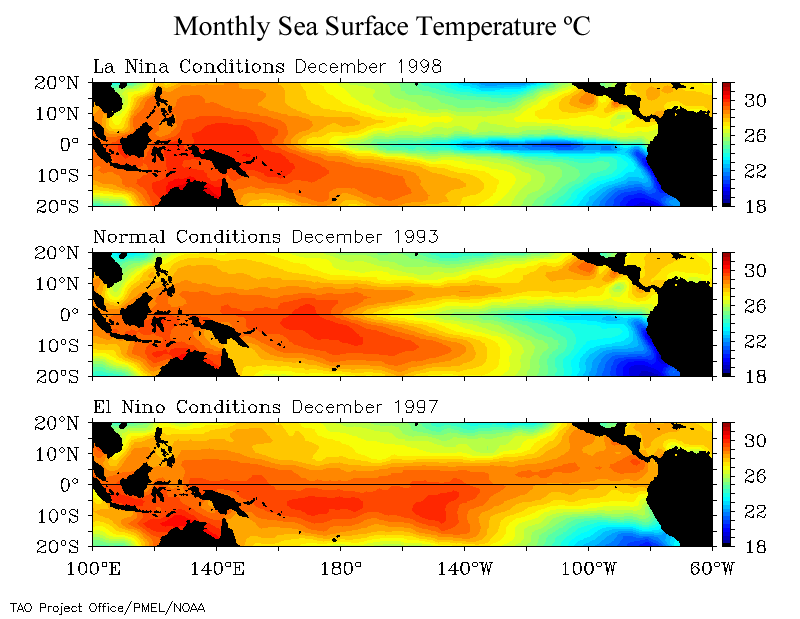
Discrepancies in sea surface temperature (SST) and air pressure around the central and eastern equatorial Pacific drive these canonical weather patterns. When the SST of that equatorial water mass is roughly equal to a historical average temperature, we see neutral conditions. Colder-than-average sea surface temperatures result in La Niña, and warmer-than-average sea surface temperatures drive an El Niño pattern. El Niño, La Niña, and neutral conditions are the phases of the El Niño Southern Oscillation (ENSO), which describes this pattern of heating and cooling.
The ENSO is driven by trade winds, which blow from east to west across the Pacific as a result of high pressure along the Equator and the Earth’s rotation. In La Niña years, the Eastern Pacific cools while water in the tropical Western Pacific remains warm. This results in a steeper pressure gradient along which trade winds intensify. The trades move warm water on the surface with them as they travel west, and that displaced water is replaced by nutrient-rich colder water from below – a process more commonly known as upwelling. El Niño is associated with warmer water in the east and, consequently, with a less intense pressure gradient. This means weaker trades and less upwelling, thus receiving less nutrient influx.
Are we in for an El Niño in 2026?
The ENSO has shifted between La Niña and neutral conditions since 2024, and we are currently experiencing a weak La Niña. As of March 2026, NOAA maintained a La Niña Advisory, but attached a 60% probability to a transition from La Niña to ENSO-neutral between February and April 2026. In this case, there is a 56% chance this neutral pattern would persist through summer. Simultaneously, the probability of El Niño rises to around 40% from May to July. All of this to say, the path from neutral to a full El Niño regime exists but is far from guaranteed.
What does El Niño mean for fishing in San Diego?
Highly Migratory Species
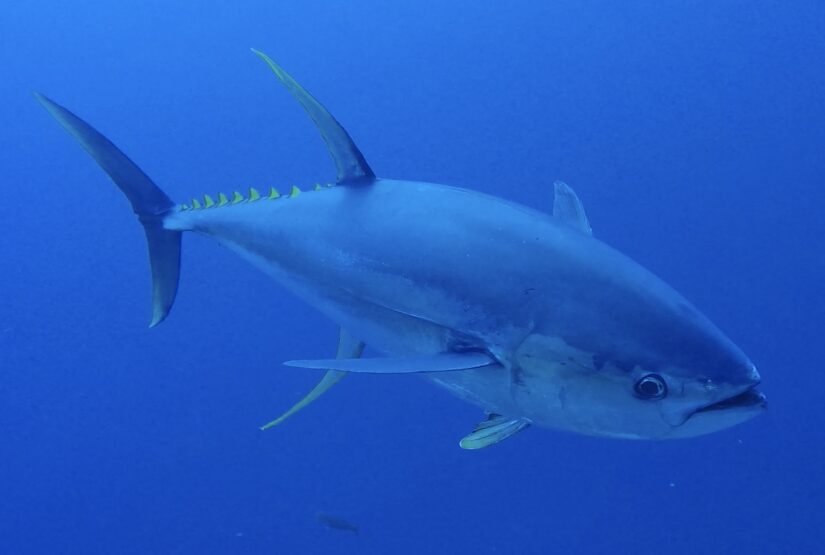
During El Niño, the California Current experiences reduced input of cold, nutrient-rich waters from upwelling and sees an increased injection of warm, nutrient-poor water from the tropics into the Southern California area. This means the water off of San Diego gets warmer and less productive at the base of the food chain, but at the same time, more hospitable to tropical and subtropical species that would otherwise not venture this far north.Thus, the lore surrounding fishing during El Niño. During the infamous El Niño of 2015-2016, San Diego’s pelagic fishery (along with most of Southern California) transformed into a Central America replicate. Wahoo appeared on the 9-mile bank, big yellowfin tuna were abundant, bluefin tuna came in close, and plentiful dorado and marlin topped it all off. Such prizes are not necessarily a sure bet in any given El Niño – wahoo did not make a return to California waters during its most recent occurrence in 2023-2024 as far as the interwebs and word-of-mouth can say – but monitoring SST for anomalous warmth might give insight into these possibilities for 2026.
Invertebrates
The same El Niño of 2015-2016, such a boon it was for game fish, also contributed to massive algal blooms which particularly affected invertebrate fisheries. Those blooms yielded high levels of domoic acid, a bioaccumulating neurotoxin, making many invertebrates unsafe for consumption. This resulted in the closure of the rock crab year-round fishery north of the Ventura-Santa Barbara County line, and a delay in the opening of the dungeness crab fishery – both lasting months.
While San Diego’s premier invert fishery, lobster, has little overlap with high season for algal blooms (spring-late summer), El Niño tends to shift what is typical. It will be worthwhile to keep an eye on algal bloom productivity in San Diego if we are to enter an El Niño.
Groundfish
Rockfish and other groundfish seem to respond to warmth by seeking cold, at least in the short term and as it pertains to fishing. Reduced upwelling and warmer surface temperatures have, in the past, resulted in these fish moving deeper or further north, towards cooler water. Targeting these species during El Niño might require exploring more varied grounds.
Coastal Pelagics
Prior to the severe marine heat wave associated with the El Niño of 2015-2016, northern anchovies and sardines were thought to follow a predictable pattern, where anchovies were typically more abundant in years with cooler water and sardines more so in warmer water. Curiously, during and since “The Blob”, as the heatwave is known, anchovies became and have remained the dominant forage fish in Southern California, even under a warmer regime. Scientists are investigating the cause of this pattern shift, and as such, it is uncertain what El Niño might mean for coastal pelagic abundance off of San Diego.
In Conclusion
It remains to be seen what 2026 will bring. There is a chance of neutral conditions persisting through the summer, with El Niño a real but not certain possibility on the horizon. Keep an eye on NOAA’s ENSO updates closely (found here) as the year progresses to know what to expect in the coming months.
References:
https://www.ncei.noaa.gov/access/monitoring/enso/technical-discussion
https://reports.news.ucsc.edu/west-coast
https://caseagrant.ucsd.edu/our-work/resources/red-tides-california
https://www.pmel.noaa.gov/elnino/fish-distribution
https://pmc.ncbi.nlm.nih.gov/articles/PMC3746886
https://www.nature.com/articles/s41467-023-42966-0
https://www.meltontackle.com/blog/el-nino-fishing
https://www.cdph.ca.gov/Programs/CEH/DRSEM/Pages/EMB/Shellfish/Domoic-Acid.aspx
Photos: